1885 — 1916 · Imperial Series
First Fabergé Egg
In 1885, Alexander III presented Empress Maria Feodorovna with the first Fabergé Easter egg, giving birth to a series of fifty imperial creations. Each of these unique works conceals a refined surprise, a symbol of the talent, elegance, and excellence of the House of Fabergé.
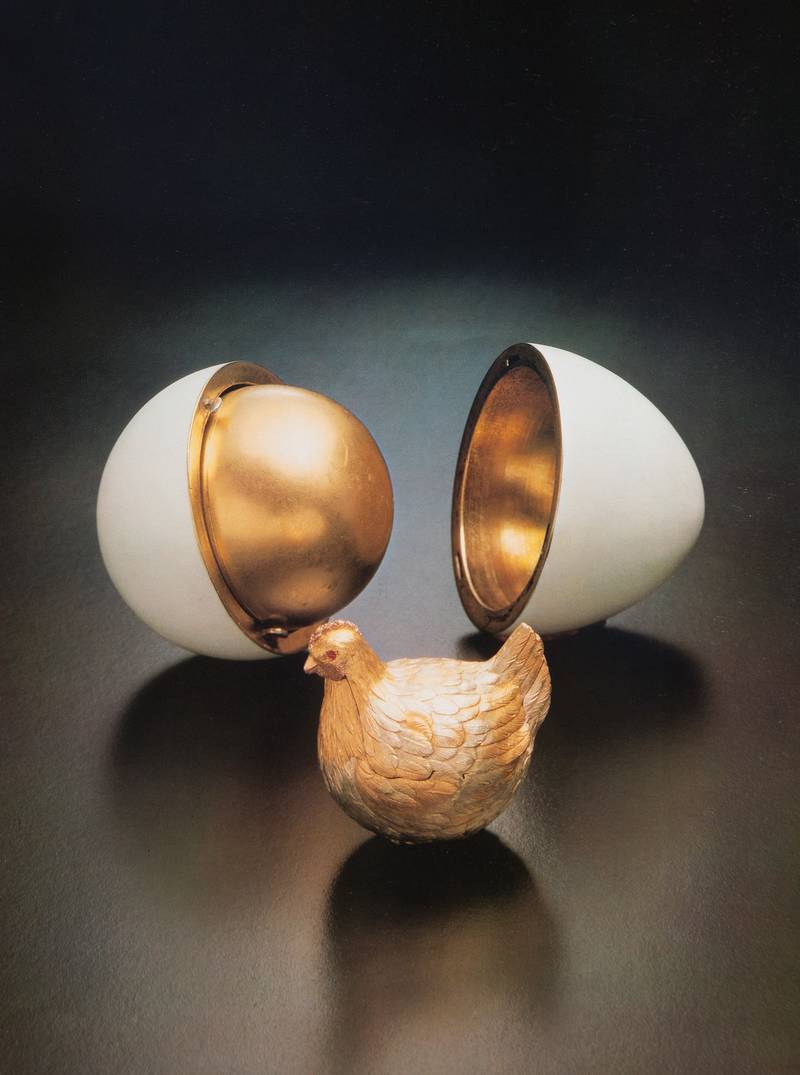
First Imperial Egg
First Hen Egg
Presented by Alexander III to Maria Feodorovna · Easter 1885
The first of the Imperial series, this egg of deceptive simplicity contains a treasure. The opaque white enamel shell hides a solid gold interior within which nestles a gold hen with eyes set with rubies.
Drawing free inspiration from an 18th-century egg kept at the Danish court, Fabergé reinterpreted the object with a technical mastery that immediately captivated the Emperor. From then on, the annual commission became an uninterrupted tradition lasting thirty-one years.
Technical Specifications
Materials
Opaque white enamel, gold, rubies
Interior Surprise
Gold hen, ruby eyes
Creation Date
1885 — Easter
Patron
Tsar Alexander III
Recipient
Empress Maria Feodorovna
Current Location
Fabergé Museum, Saint Petersburg
Chronology
The tradition of Orthodox Easter eggs is deeply rooted in Russian culture. By entrusting this commission to Fabergé in 1885, Alexander III elevated a popular custom to the rank of imperial art. The success was immediate: the Empress was delighted, and the Emperor renewed the commission every year.
Upon the death of Alexander III in 1894, Nicholas II perpetuated and expanded the tradition by henceforth commissioning two eggs annually — one for his mother Maria Feodorovna, and the other for his wife Alexandra Feodorovna. The Imperial series thus comprises fifty pieces created between 1885 and 1916, the date at which the First World War brought the commissions to an end.
Each egg was subject to absolute secrecy: the interior surprise was known only to Fabergé himself until the moment of presentation. This creative rigor, combined with unequaled technical mastery, forged the legend of the House.
Remarkable Eggs of the Series
Œuf à la montre
Œuf en or émaillé dissimulant une montre de dame. Première surprise horlogère de la série.
Œuf du Mos-Kovs
Miniature du croiseur en or et platine, réplique exacte du navire impérial à l'échelle.
Œuf du Transsibérien
Train miniature en or et platine reproduisant le Transsibérien express, avec locomotive à vapeur fonctionnelle à la clé.
Œuf du Kremlin de Moscou
Réplique architecturale en or émaillé du Kremlin. Les cloches actionnées par un mécanisme intérieur sonnent l'heure.
Œuf du 15e anniversaire
Seize miniatures peintes célèbrent le règne de Nicolas II. Portrait de la famille impériale en médaillons d'or.
Œuf Romanov tercentenaire
Célèbre trois siècles de la dynastie Romanov. Portrait en médaillons de tous les tsars depuis Michel Ier.
“Our firm will never be satisfied if it does not surpass everything that has been done before.”
Carl Fabergé